Scaling from Lab to Commercial Production The Process Vessel

Scale-up from Lab to Commercial Production: The Process Vessel Challenge Nobody Talks About

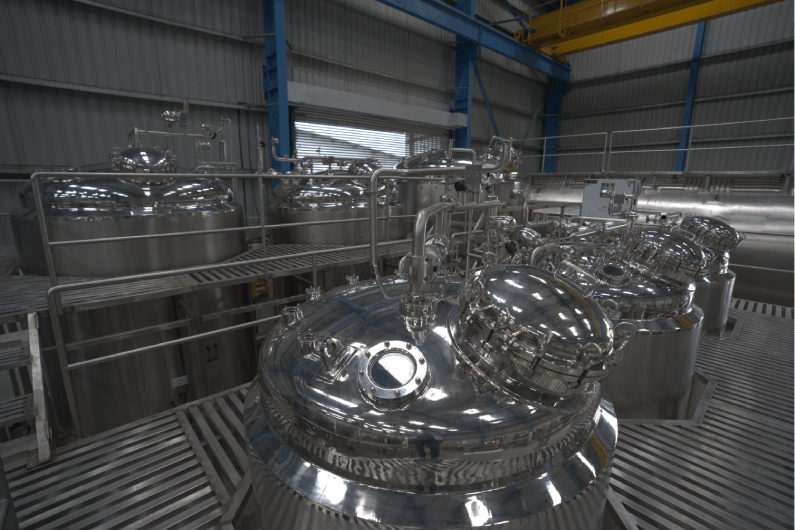
In pharmaceutical and biopharmaceutical manufacturing, breakthroughs often begin in controlled laboratory environments where formulations are developed in 5L, 10L, or 50L vessels. At this stage, process parameters are tightly monitored, batch volumes are manageable, and production seems highly predictable. Then comes commercialization.

The transition from a 10L R&D vessel to a 10,000L or 50KL commercial production system often appears straight forward on paper—simply use a larger vessel and replicate the same process parameters.

But scale-up is where many pharmaceutical companies face their biggest operational setbacks.

Batch inconsistencies begin to appear. Mixing times increase. Heating cycles become longer. Sterility risks multiply. Validation becomes more complex.

And at the center of these issues lies a critical piece of equipment many companies underestimate:

The process vessel.

Why Scale-up Is Not Just About Increasing Vessel Size

One of the most common assumptions in pharmaceutical manufacturing is that scale-up production simply means increasing batch volume while maintaining the same operating conditions.

However, process physics changes dramatically with vessel size.

A formulation that mixes perfectly in a 10L vessel may behave entirely differently in a 10,000L system because:

• Fluid flow dynamics change
• Heat transfer efficiency reduces
• Shear rates vary
• Product settling may occur
• Sterility complexity increases
This is where process vessel engineering becomes critical.

The Mixing Challenge: Why Bigger Tanks Don’t Behave the Same

Mixing is often the first major problem during scale-up.

In small lab vessels:
• Ingredients disperse quickly
• Fluid circulation is predictable
• Mixing times are shorter

In larger vessels:
• Dead zones may develop
• Powder dissolution slows down
• Product settling becomes common
• Shear-sensitive molecules may degrade

This becomes especially critical for:
• Vaccines
• Biosimilars
• Monoclonal antibodies
• Ophthalmics
• Sterile injectables

To understand this, consider impeller tip speed, which directly affects shear forces.

Tip Speed=πDN

Where:
• D = Impeller diameter
• N = Rotational speed

Lab Scale-up Example:

A 10L vessel may use:
• Impeller diameter = 0.1 m
• Speed = 300 RPM

Tip Speed=π(0.1)(5)=1.57 m/s

Commercial Scale-up Example:

If the production vessel has a 1-meter impeller:
N=1.57 / π(1)=30 RPM

Running the larger vessel at the same 300 RPM would create excessive shear and potentially damage sensitive biologics

Power Demand Increases Faster Than Most Teams Expect

Many manufacturers underestimate the energy required for large mixing.

Power consumption follows this equation:
P=Np ρN3 D5

Because power depends on D⁵, increasing impeller diameter dramatically increases power demand.

For example:
(0.1)5 / (1)5 = 100,000
A poorly optimized scale-up strategy can significantly increase energy consumption and operational costs.

Heat Transfer Becomes a Major Bottleneck

Temperature control is critical in sterile manufacturing.

At lab scale-up, heating and cooling happen quickly due to smaller volumes.

At commercial scale-up, thermal efficiency drops significantly.

Heat required follows:

Q=mCp ΔT

For a 10L batch:

Q=10(4.18)(60)=2508 kJ

For a 10,000L batch:

Q=10,000(4.18)(60)=2,508,000 kJ

This explains why larger systems require:
• Efficient jackets
• Limpet coils
• Proper insulation
• Advanced thermal automation 

Surface Area Shrinks Relative to Volume

Another hidden challenge is declining surface area-to-volume ratio.

SA : V = 3/r

As vessel radius increases:
• Surface area per unit volume decreases
• Heat transfer slows
• Cooling cycles become longer 

This often delays production schedules.

Sterility Risks Multiply at Commercial Scale-up 

As vessel systems grow larger, so do contamination risks.

Additional components include:
• Pumps
• Transfer lines
• Valves
• Sensors
• Filtration skids
• Sampling ports 

Every additional connection increases contamination risk.

Poor design may introduce:
• Dead legs
• Incomplete drainage
• Inefficient SIP cycles
• Manual intervention points 

For sterile manufacturing, even one contamination event can lead to complete batch rejection.

Cleaning Costs Increase Rapidly

CIP requirements expand significantly during scale-up.

A lab vessel may consume:
• 50L per cleaning cycle 

A commercial vessel may consume:
• 5,000L per cycle

At two cycles per day:

5000×2=10,000 L/day

Annual consumption becomes:
10,000×365=3.65 million liters/year

This directly impacts sustainability targets and utility costs.

The Financial Impact of Poor Scale-Up

Scale-up failures can become extremely expensive.

If one biologics batch is worth ₹2 crore and two batches fail annually:
2×₹2 crore=₹4 crore/year

This excludes:

• Validation delays
• Regulatory setbacks
• Lost market opportunities 

Why Custom Process Vessel Design Matters

No two pharmaceutical products behave the same way.

A vessel designed for oral syrups may fail in:
• Vaccines
• Biosimilars
• Cell culture media
• Buffer preparation
• High-shear formulations 

Modern process vessels must be customized for:
• Product sensitivity
• Batch size
• Mixing requirements
• Sterility requirements
• Automation needs
• Future scalability 

Final Thoughts

Scale-up in pharmaceutical production is not simply about making larger batches.

It’s about understanding how physics, engineering, sterility, and automation evolve at larger volumes.

The right process vessel accelerates commercialization.

The wrong one can delay product launches, increase costs, and compromise product quality.

And that’s the process vessel challenge nobody talks about—but every growing pharmaceutical company eventually faces.
Share this post:

For 20 years, we’ve been the go-to problem-solvers for high-purity and injectable process applications in the pharma and biopharma industry. We are relentless about continuous process improvement and upskilling, elevating ourselves and our technology so you can get the job done more efficiently with cost optimisations. Use the form below to schedule a call back from our team.

Name(Required)
Address
This field is for validation purposes and should be left unchanged.

Hetal Panchal is the Vice President in Operations department of TSA Process Equipments (A Thermax Group Company) since 1 s t October 2012.

Holding a qualification in Production Engineering and 28 years of industry experience, he specializes in designing advanced equipment for the pharmaceutical sector. His expertise lies in optimizing production lines, improving efficiency, and ensuring compliance with regulatory standards.
Focused on innovation, he has developed systems that enhances productivity, minimizes downtime, and maintains product quality. Staying current with technological trends, they contribute to ongoing improvements in the industry.
His extensive experience has helped identify opportunities for innovation, streamlining operations and reducing costs. Through his specialized knowledge, more efficient manufacturing processes and higher-quality outputs in pharmaceutical production are delivered.

B.C. Mahesh is the Chairperson of TSA Process Equipment Pvt. Ltd. since Feb 2024.

B.C. Mahesh became a member of the Executive Council in August 2013. He is responsible for the Industrial Product Business (IPB), which consists of Process Heating, Absorption Cooling & Heating Solutions, Water and Waste Solutions, Air Pollution Control, Steam Engineering, Channel Business Group, International Business Group, and Enterprise Sales businesses.
As part of IPB, he also oversees the following wholly-owned subsidiaries
of Thermax – Danstoker, PT Thermax International Indonesia and Rifox.Mahesh joined Thermax as a graduate trainee in 1988 and handled the Materials function for various businesses, including global sourcing, till 1996.
He moved to the Power division(P&ES) and grew to the position of Sales Head and subsequently Head of Projects. He took over as the Head of the SBU for Medium Power Plants in 2009 and finally as Head of Power business in 2012.
Mahesh has worked with Thermax for over 30 years in many functions such as manufacturing, supply chain, sales and marketing, and project management, and has played a significant role in the strategy, expansion and diversification of the Power business.Mahesh completed his Mechanical Engineering from the Visvesvaraya Regional College of Engineering, Nagpur in 1988.

Vishal Mehra is the Director of TSA Process Equipment Pvt. Ltd. since Feb 2024.

Mr. Vishal Mehra is currently serving as the Strategic Business Unit Head for Water & Waste Solutions (WWS) at Thermax Limited. Additionally, he holds a directorial position at TSA Process Equipment, which is known for its expertise in ultra-pure and high-purity water technologies and was recently acquired by Thermax.With over 22 years of experience in the industry, Mr. Mehra’s professional focus includes water management solutions, advanced technology development, and business strategy.
His areas of interest encompass cutting-edge technology, growth strategies, organizational effectiveness, and development.
Mr. Mehra is well qualified in business management and strategy transformation, having completed the Senior Executive Program in Business Management and Strategy Transformation from London Business School. This advanced education supports his extensive experience and expertise in the field.

Sandeep Deshpande has been the Director of TSA Process Equipments Pvt. Ltd. since February 2024.

Currently, he serves as the Head of Corporate Finance and the Industrial Product Group at Thermax Limited. With over 21 years of experience in finance, he has developed expertise in financial consolidation, planning, reporting, costing, accounting, controlling and financial modeling.
Sandeep is a qualified Cost Accountant Company Secretary, and holds a diploma in IFRS and an advanced diploma in financial management from XLRI. He has extensive experience in financial operations, including financial planning, MIS, budgeting, controlling, audits, and cash flow management. His expertise also spans financial reporting, consolidation, mergers and acquisitions, due diligence, business restructuring, and implementing Internal Financial Control (IFC) and Enterprise Risk Management (ERM). Additionally, Sandeep has hands-on experience with Oracle systems, automation, digitization, and business analytics. He is passionate about driving good governance, improving financial reporting, and leveraging automation and digitization to enhance business analytics.

Rajiv Parikh is the COO of TSA Process Equipments (A Thermax Group Company) since April 2024.

Rajiv is a highly accomplished professional with extensive experience in the pharmaceutical and FMCG sectors, specializing in high-purity and process vessels. He played a key role in establishing TSA Process Equipments Pvt. Ltd., driving its growth and success. His deep technical expertise, combined with a strong understanding of client needs, has enabled him to deliver innovative solutions to complex industry challenges.

Throughout his career, Rajiv has excelled in leadership and sales, consistently launching cutting-edge products that have positively impacted the market. His ability to build lasting client relationships and offer tailored solutions has earned him a reputation as a trusted industry leader.

With a background in Mechanical Engineering, Rajiv blends technical proficiency with strategic vision. His contributions have shaped industry standards and positioned him as a key influencer in the pharmaceutical and FMCG sectors.

Apurva Shah is the CEO of TSA Process Equipments (A Thermax Group Company) since April 2024.

With a career spanning over 24 years, Apurva is the visionary CEO of TSA Process Equipments, where he has led the company to new heights in the High Purity & process equipment industry. A graduate in Mechanical Engineering from Mumbai University, followed by an MBA in Business Management from NMIMS, He brings a strong technical foundation combined with a sharp strategic mindset.

His expertise lies in formulating and executing strategies that drive growth and operational efficiency. Over the years, he has cultivated a deep understanding of market dynamics, positioning TSA Process Equipments for continued success in a competitive landscape.

Outside of his professional pursuits. He is an avid reader, with a particular interest in fiction novels, which fuel his creativity and broaden his perspective.