The Critical Role of Temperature Control in Sterile Manufacturing Vessels
A Technical Perspective for Pharma Executives and Plant Leaders
In sterile pharmaceutical manufacturing particularly for injectable dosage forms such as vaccines, biologics, and parenteral solutions temperature control is not merely an operational parameter. It is a validated critical process parameter (CPP) directly influencing product quality attributes (CQAs), sterility assurance, and regulatory compliance.
For executives, temperature stability translates into batch reliability, audit readiness, and cost control. For technical leaders, it directly impacts formulation chemistry, heat transfer efficiency, microbial control, and process validation.
This article examines temperature control from both strategic and engineering perspectives, highlighting why it remains one of the most critical yet underestimated aspects of sterile manufacturing vessel design.
Why Temperature Stability Is Non-Negotiable in Injectable Drug Manufacturing
Every injectable formulation is governed by thermodynamics and reaction kinetics. Chemical degradation follows the Arrhenius principle, where reaction rate increases exponentially with temperature. Even a small deviation of 2–3°C can accelerate hydrolysis, oxidation, or API breakdown in sensitive formulations. Reaction rates follow the Arrhenius equation:
k=Ae^(-E_a/RT)
Where:
k= reaction rate constant
E_a= activation energy
R= gas constant
T= absolute temperature
A small increase in temperature can exponentially accelerate degradation. For temperature-sensitive biologics, even a 2–3°C deviation can significantly alter stability profiles.
From a regulatory standpoint (USFDA, EMA, WHO GMP), validated temperature ranges must be maintained throughout formulation, holding, and transfer stages.
The Challenge in Biologics and Vaccines Formulations:
In biologics and vaccines, the challenge is even more critical. Proteins are structurally delicate molecules; excessive heat can lead to
- Protein denaturation,
- aggregation,
- loss of tertiary structure.
- Reduced biological activity.
On the other hand, insufficient temperature control during certain formulation steps can result in
- incomplete dissolution,
- improper homogenization,
- viscosity instability.
This means temperature does not merely “support” formulation it defines whether the product will meet its stability profile and release specifications.
Operational Consequences of Poor Thermal Control
Poor temperature management can directly result in:
- Accelerated degradation kinetics
- Phase separation in emulsions.
- Viscosity drift affecting mixing efficiency
- Reduced shelf-life and potency
- Increased out-of-specification (OOS) events
For plant management, these translate into
- batch rejections,
- deviation investigation cycles,
- Production delay
- financial losses.
Why Standard Manufacturing Vessels Often Fall Short
Despite the vital role temperature plays, many facilities still rely on outdated or improperly designed vessels that cannot guarantee uniform thermal conditions.
Common design limitation includes:
- Partial or inefficient jacket coverage
- Poor heat transfer efficiency
- Limited temperature sensing points
- Manual or slow control response
- Lack of integrated process automation
These problems become even more severe when systems are scaled up for large-volume production, where precise thermal management becomes increasingly difficult.
Another common challenge is the failure to differentiate between process heating requirements and SIP (Steam-In-Place) heating requirements, resulting in:
- Overcomplicated control systems
- Inefficient heating cycles
- Thermal stress on equipment components
Without validated thermal performance, such systems introduce process variability, compliance risk, and higher operating costs.
The Engineering Reality: Uniformity Over Setpoint
One of the most common misconceptions we encounter is that achieving a displayed temperature equals achieving thermal control. In reality, large-scale sterile vessels present complex heat transfer challenges.
As vessel volume increases, the surface-area-to-volume ratio decreases. This affects heating and cooling dynamics, potentially creating thermal gradients between the top, center, and bottom zones of the vessel. Without optimized jacket design and effective agitation, the system may develop:
- Hot spots near jacket surfaces
- Cold pockets within bulk solution
- Delayed cooling response
- Inconsistent batch temperature profiles
These gradients compromise reproducibility an unacceptable risk in injectable manufacturing.
At TSA, our vessel designs focus on achieving thermal uniformity across the entire working volume, not just nominal temperature reading.
_____________________________________________________________________________
Microbial Control and SIP Integrity
Temperature precision also plays a vital role in sterility assurance. Inconsistent temperatures during holding phases can encourage condensation, creating favorable conditions for
- microbial growth
- biofilm formation.
During Steam-In-Place (SIP) cycles, uniform temperature distribution is critical to achieving validated lethality. Cold spots compromise sterilization efficiency and regulatory compliance. That is why we engineer our vessels to ensure:
- Uniform steam distribution
- Validated thermal mapping
- Optimized condensate drainage
- Controlled transition between process and SIP modes
Our systems are designed to maintain sterility without inducing thermal stress on gaskets, seals, or internal components.
________________________________________
Addressing the Limitations of Conventional Vessels
Many legacy systems were not originally engineered for modern sterile injectable requirements. These setups often lack:
- Incomplete heating/cooling jacket coverage
- Multi-point temperature sensing
- Advanced PID cascade control
- Real-time deviation logging
- Seamless process-to-SIP automation transitions
Such limitations lead to temperature overshoot, undershoot, and excessive energy consumption while increasing deviation risk.
At TSA Process Equipments, we approach temperature control as an integrated engineering discipline combining mechanical design, thermal science, and automation architecture.
________________________________________________________________________________________
How TSA Ensures Thermal Precision
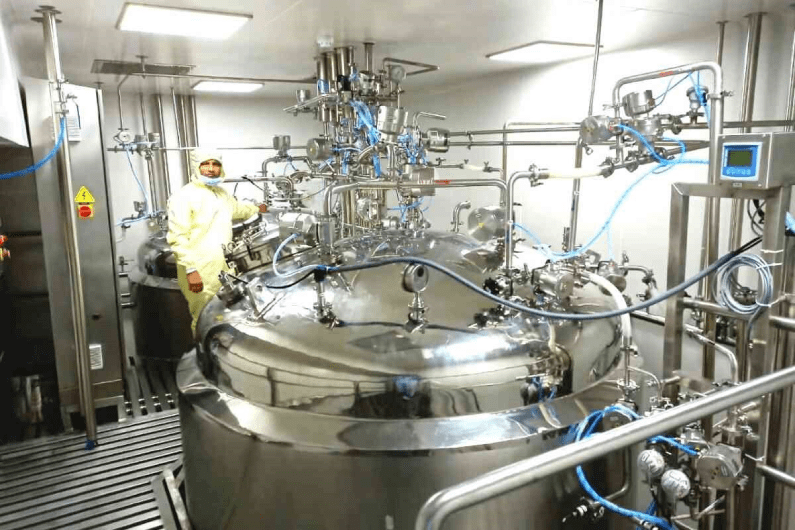
Our jacketed sterile manufacturing vessels are engineered specifically for pharmaceutical GMP environments. Each system is designed with:
- Optimized jacket geometry for maximum heat transfer efficiency
- Zoned thermal control for controlled ramp-up and ramp-down
- Strategically positioned multi-point RTDs
- PLC-based cascade PID control systems
- Alarm-based deviation monitoring and data integrity compliance
In addition, our insulation strategies minimize heat loss, maintain idle temperature stability, and improve overall energy efficiency reducing operational expenditure without compromising performance.
Before handover, every system undergoes rigorous thermal mapping and validation support aligned with IQ, OQ, and PQ requirements. Our documentation packages are structured to facilitate smoother audits and regulatory inspections.
_____________________________________________________________________________
A Strategic Investment in Reliability
In high-value injectable manufacturing, a single rejected batch can represent significant financial and reputational loss. Temperature instability affects not only formulation chemistry but also:
- Batch-to-batch consistency
- Regulatory inspection outcomes
- Energy consumption
- Equipment lifecycle performance
- Long-term brand credibility
We believe thermal control should not be treated as an optional feature it is a foundational element of sterile process design.
_____________________________________________________________________________
Our Commitment to Your Process Integrity
At TSA Process Equipments, we partner with pharmaceutical manufacturers to design vessels that eliminate variability, reduce operational risk, and protect product quality at every stage of sterile manufacturing.
From biologics to parenteral solutions, our thermal engineering philosophy focuses on precision, validation readiness, and long-term reliability.
Because in sterile injectable manufacturing, every degree matters and precision defines performance.